CopilotKit Bridges the Agent-to-UI Gap with Generative Components and the AG-UI Protocol
34k-star CopilotKit gives React (and now Angular, Vue, and React Native) developers a full SDK for wiring AI agents to dynamic UI — including human-in-the-loop flows, shared state, and backend tool rendering.
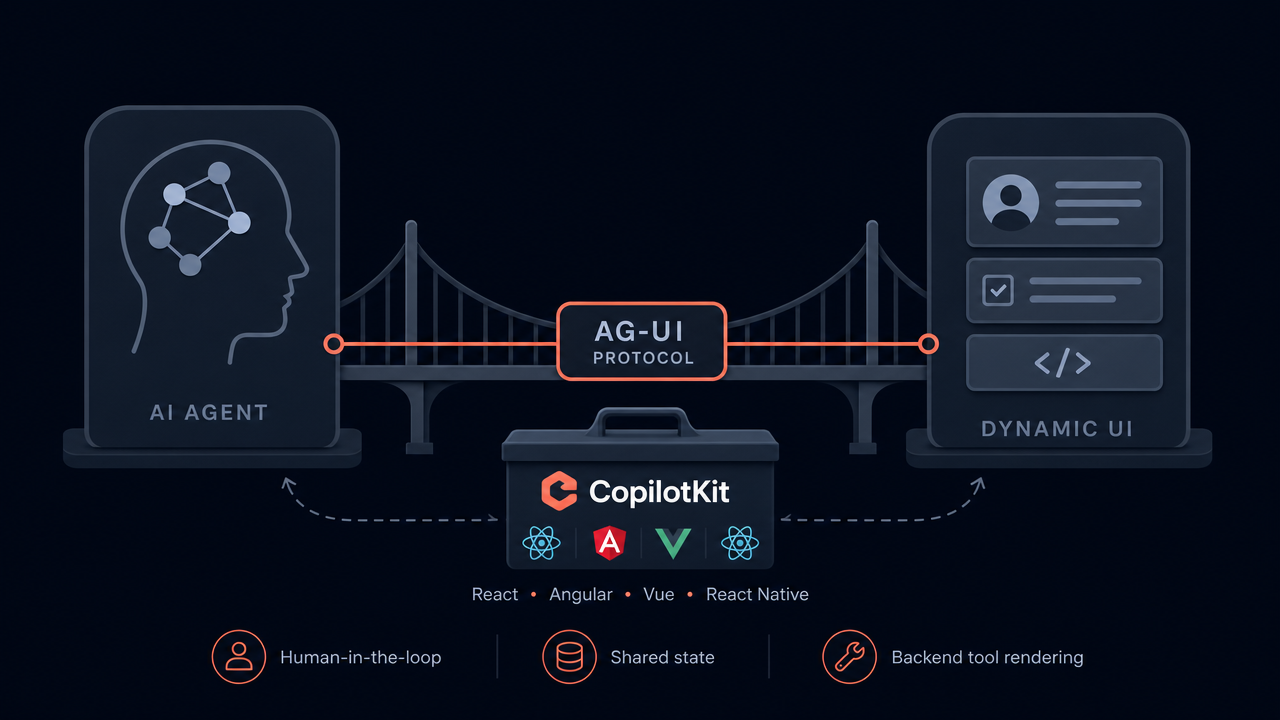
Building a capable AI agent is hard enough. Getting that agent to actually drive your UI — streaming state changes, rendering contextual components, pausing for user confirmation — has traditionally meant stitching together a pile of ad-hoc websocket glue, custom hooks, and fragile serialization logic. CopilotKit is a focused attempt to make that layer a solved problem.
The project has crossed 34k GitHub stars and now positions itself as "The Frontend Stack for Agents & Generative UI," extending well beyond its React origins into Angular, Vue, React Native, and even non-browser surfaces like Slack and Microsoft Teams.
What the SDK Actually Gives You
CopilotKit is best understood as a runtime that connects three things: your agent backend, your UI component tree, and your users — in a live, bidirectional loop. The core features map directly to pain points any developer hits when building agent-native apps:
- Chat UI — A drop-in interface with message streaming, tool-call rendering, and agent response display, fully customizable.
- Backend Tool Rendering — Agents can invoke backend tools that return UI components rendered client-side. Your agent doesn't just return text; it can return interface.
- Generative UI — Components that agents generate and update dynamically at runtime based on user intent and live agent state — not pre-baked templates.
- Shared State — A synchronized state layer readable and writable by both the agent and React components simultaneously, avoiding the usual polling or webhook hacks.
- Human-in-the-Loop — Agents can pause mid-execution to request confirmation, edits, or additional user input before continuing. This is first-class, not bolted on.
- Self-Learning via CLHF — Early-access continuous learning from human feedback, with in-context reinforcement learning and per-user adaptation — no model fine-tuning required.
Getting Started in Under a Minute
For new projects, CopilotKit ships a CLI scaffolder:
npx copilotkit@latest create -f react
For existing projects, the init command handles package installation and provider configuration:
npx copilotkit@latest init
After that, the CLI has set up the core packages, configured context and hooks, and wired the agent-to-UI connection so agents can immediately stream actions and render UI. The useAgent hook then gives you programmatic control over the agent connection directly — sitting on top of the AG-UI protocol layer.
AG-UI: The Wire Protocol Behind It All
CopilotKit is also the team behind the AG-UI Protocol, the open wire protocol that defines how agents communicate with frontend runtimes. The protocol has seen meaningful adoption: Google, LangChain, AWS, Microsoft, Mastra, and PydanticAI are all listed as adopters.
The practical implication for developers is portability. Your agent logic stays on the backend, authored once. AG-UI handles the wire protocol, and CopilotKit handles the UI layer for each target platform. The same agent that powers your Next.js app can, in principle, run as a Slack bot (already GA) or a Microsoft Teams integration (early access) without a separate agent implementation.
Platform support at a glance:
| Platform | Status |
|---|---|
| React / Next.js | ✅ GA |
| Angular | ✅ Supported |
| Vue | ✅ Supported |
| React Native | ✅ Supported |
| Slack | ✅ GA |
| Microsoft Teams | 🔒 Early access |
Where This Fits in Your Stack
CopilotKit isn't an agent framework — it doesn't replace LangChain, LangGraph, PydanticAI, or whatever orchestration layer you're already using. It's the frontend runtime that connects an existing agent to a real UI. If you've built an agent that works in a terminal or a Jupyter notebook but struggle to give it a production-quality interface with proper state sync and UX affordances, that's the exact gap CopilotKit targets.
The self-learning (CLHF) and Teams integrations are still gated behind early access, so production users today are mostly working with the core generative UI and human-in-the-loop primitives. Given the AG-UI protocol adoption list and the pace of the repo (10,839 commits), this is a project worth watching closely if you're building anything agent-native.
Discussion 0
Join the discussion
Sign in with GitHub to comment and vote.
No comments yet
Be the first to weigh in.